Research Article | | Peer-Reviewed

Climate Change and Impact Analysis of Winter Wheat Overwintering Period in Changji City in Recent 30 Years

Received: 2 December 2025     Accepted: 12 December 2025     Published: 29 December 2025
Views:       Downloads:
Abstract

Changji City is located in the main producing area of winter wheat in Xinjiang. It is of great significance to study and analyze the regional climate change and its impact on the overwintering period of winter wheat for making full use of the ratio of light, heat and water resources and developing grain production according to local conditions. The data of national meteorological station and the observation data of winter wheat development period in Changji City from 1995 to 2024 were selected. The linear regression equation, climate tendency rate, Mann-Kendall and Pearson correlation coefficient method were used to analyze the variation characteristics of average temperature, maximum temperature, minimum temperature, precipitation, sunshine hours, ≥0°C accumulated temperature and other climatic factors during the overwintering period of winter wheat in Changji City, and to judge the key climatic factors affecting the overwintering period of winter wheat. The results showed that: (1) During the overwintering period of winter wheat in Changji City, the daily average temperature, daily maximum temperature and daily minimum temperature all showed a significant downward trend, and the downward rates were 1.3, 0.5 and 2.2°C/10a, respectively. The downward trend of precipitation was not significant, and the changes of sunshine hours and ≥0°C accumulated temperature were not obvious; (2) There was a strong negative correlation between the number of winter wheat overwintering days and the daily average temperature, daily maximum temperature, daily minimum temperature and ≥0°C accumulated temperature. (3) In recent 30 years, the number of winter wheat overwintering days in Changji City showed an increasing trend, which was related to the significant decrease of daily average temperature, daily maximum temperature and daily minimum temperature.

Published in International Journal of Applied Agricultural Sciences (Volume 11, Issue 6)
DOI 10.11648/j.ijaas.20251106.13
Page(s) 232-238
Creative Commons

This is an Open Access article, distributed under the terms of the Creative Commons Attribution 4.0 International License (http://creativecommons.org/licenses/by/4.0/), which permits unrestricted use, distribution and reproduction in any medium or format, provided the original work is properly cited.

Copyright

Copyright © The Author(s), 2025. Published by Science Publishing Group

Keywords

Changji City, Winter Wheat, Overwintering Period, Climate Change, Impact

1. Introduction
Changji City of Xinjiang Uygur Autonomous Region is located in the hinterland of the Eurasian continent and the southern margin of the Junggar Basin. It belongs to the mid-temperate continental arid climate zone. It has the characteristics of cold winter, hot summer and large temperature difference between day and night . Affected by the topography, the climate varies greatly from south to north. There is more summer precipitation in the southern mountainous area, and the desert climate characteristics in the north are significant .
The total area of Changji City is 79.74×10⁴ hm2, and the per capita cultivated land of farmers and herdsmen is 0.4 hm2. The landform types are generally divided into three parts: mountain, plain and desert. The terrain is high in the south and low in the north, showing a stepped shape. The middle part is an alluvial plain with high soil organic matter content, which is suitable for planting all kinds of crops. It is an important producing area of grain crops in Xinjiang.
In 2023, the planting area of grain crops in Changji City will be 16228.5 hm2, of which the planting area of winter wheat will be 5252.8 hm2, accounting for 31.1% of the total area of grain crops .
The winter wheat planting varieties in Changji City are mainly medium-strong gluten winter wheat varieties, taking into account the medium-gluten super-high-yield varieties, including Xindong 18, Xindong 22, Xindong 52, Xindong 53, etc. It is suitable to sow winter wheat with daily average temperature of 14 ~ 18°C. The accumulated temperature of ≥ 0°C before winter reaches 350 ~ 650°C, and there are 2~4 tillers at the beginning of overwintering . When the average temperature in autumn is stable below 3°C, the aboveground part of winter wheat stops growing and begins to enter the overwintering stage. According to the investigation and statistics of the agricultural department of Changji Prefecture, the overwintering period of winter wheat in Changji City is generally from the middle of November to the middle and late March of the next year.
The growth and development of winter wheat is closely related to climatic conditions. Many experts and scholars have studied and analyzed the impact of climate change on the overwintering period of winter wheat. Jing Yigang et al showed that compared with the 1980 s, the starting date of winter wheat in the southern part of northern Shaanxi was delayed by about 4 days on average, and that in Guanzhong was delayed by about 8 days on average. Li Tongxiao et al pointed out that the number of winter wheat overwintering days in most areas of Henan Province from 1957 to 2007 showed a shortening trend. Hu Xunyu et al analyzed that the temperature increased by 0.53 ℃·10a-1 during the wintering-regreening period in the North China Plain from 1961 to 2008. Xie Fang et al analyzed that, the climate warming trend during the growth period of winter wheat in Bachu County from 1983 to 2012 was obvious. The start of overwintering and the returning green period of winter wheat were delayed, and the whole growth period was shortened. As we all know, food security is related to national security. Changji City is located in the main winter wheat producing area along the Tianshan Mountains in northern Xinjiang. It is of great significance to study and analyze the climate change and its impact on the overwintering period of winter wheat in Changji City for making full use of the ratio of light, heat and water resources and developing food production according to local conditions.
2. Materials and Methods
2.1. Data Source
The meteorological data of the national basic meteorological station in Changji City from 1995 to 2024 and the observation data of winter wheat development period were selected. The meteorological factors included daily data such as average temperature, maximum temperature, minimum temperature, precipitation, sunshine hours, and ≥ 0°C accumulated temperature. The growth period of winter wheat was divided into seven key periods: sowing and seedling period, tillering period, overwintering period, regreening period, jointing period, heading and flowering period, and filling and maturity period . Because winter wheat is a cross-year overwintering crop, the harvest year of winter wheat is taken as the growth year of winter wheat, that is, from the autumn sowing of the previous year to the harvest of the next year (September of the previous year to July of the next year).
2.2. Computing Technique
The variation characteristics of climatic factors such as average temperature, maximum temperature, minimum temperature, precipitation, sunshine hours and ≥0°C accumulated temperature during the overwintering period of winter wheat in Changji City were statistically analyzed by using linear regression equation and climate tendency rate method. The trend of winter wheat overwintering period was analyzed and the Mann-Kendall method was used to test the mutation . Pearson correlation coefficient and scatter plot method were used to analyze the correlation between winter wheat overwintering period and climatic factors in the same period, so as to determine the key climatic factors affecting winter wheat overwintering period in Changji City.
3. Results and Analysis
3.1. Variation Characteristics of Climatic Factors in Winter Wheat Overwintering Period
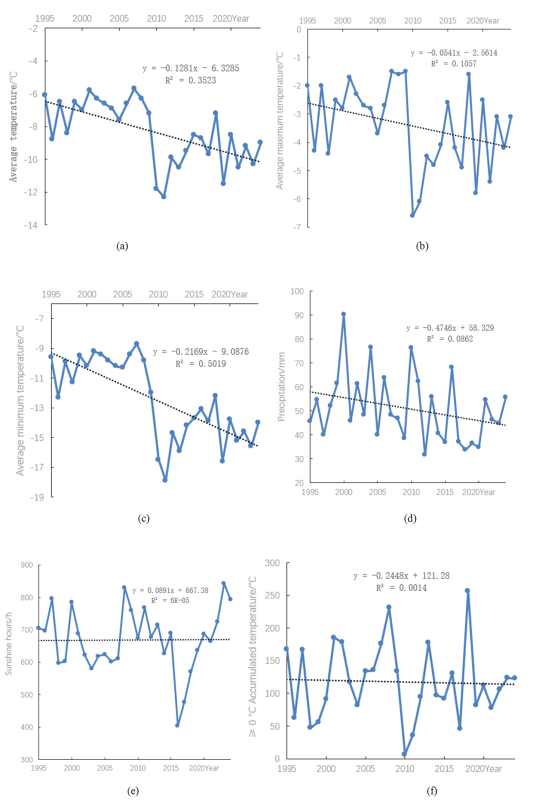
The regression analysis method was used to draw the change trend map of average temperature, maximum temperature, minimum temperature, precipitation, sunshine hours, ≥ 0°C accumulated temperature and other climatic factors during the overwintering period of winter wheat in Changji City from 1995 to 2024 (from mid-November of the previous year to mid-March and late March of the next year) (see Figure 1).
Figure 1. The Change Trend of Climatic Factors in Winter Wheat Overwintering Period in Changji City from 1995 to 2024.
(a the trend of daily average temperature change, b is the change trend of daily average maximum temperature, c is the variation trend of daily average minimum temperature, d is the change trend of precipitation, e is the change trend of sunshine hours, f is the change trend of ≥ 0°C accumulated temperature).
According to the analysis, the daily average temperature of winter wheat in Changji City during the overwintering period in the past 30 years showed a significant downward trend, with a trend coefficient r = 0.5935. Through the significance test of 0.001, the decline rate was 1.3°C / 10 a. The highest value of daily average temperature appeared in 2007, which was -5.7°C, and the lowest value appeared in 2011, which was -12.3°C. The daily average maximum temperature trend coefficient r = 0.3882, through the 0.05 significance test, showed a downward trend, the rate of decline was 0.5°C / 10a. The daily average minimum temperature trend coefficient r = 0.7084, through the 0.001 significance test, showed a significant downward trend, the rate of decline was 2.2°C / 10a. The precipitation during the overwintering period showed an insignificant downward trend. The maximum value appeared in 2000, which was 90.2 mm, the minimum value appeared in 2012, which was 31.7 mm, and the maximum difference was 58.5 mm. Sunshine hours and ≥ 0°C accumulated temperature did not pass the significance test, and the change trend was not obvious.
3.2. Trends of Winter Wheat Qverwintering Period
According to the analysis, the daily average temperature of winter wheat in Changji City during the overwintering period in the past 30 years showed a significant downward trend, with a trend coefficient r = 0.5935. Through the significance test of 0.001, the decline rate was 1.3°C / 10 a. The highest value of daily average temperature appeared in 2007, which was -5.7°C, and the lowest value appeared in 2011, which was -12.3°C. The daily average maximum temperature trend coefficient r = 0.3882, through the 0.05 significance test, showed a downward trend, the rate of decline was 0.5°C / 10a. The daily average minimum temperature trend coefficient r = 0.7084, through the 0.001 significance test, showed a significant downward trend, the rate of decline was 2.2°C/ 10a. The precipitation in the overwintering period showed an insignificant downward trend. The maximum value appeared in 2000, which was 90.2 mm. The minimum value appeared in 2012, which was 31.7 mm, and the maximum difference was 58.5 mm. Sunshine hours and ≥ 0°C accumulated temperature did not pass the significance test, and the change trend was not obvious.
3.3. Change Trend of Winter Wheat Overwintering Days
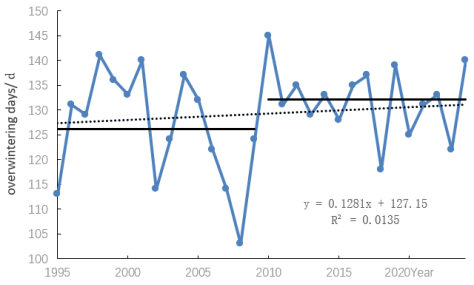
The regression analysis method was used to draw the change trend map of the number of winter wheat overwintering days in Changji City from 1995 to 2024 (see Figure 2).
Figure 2. Variation Trend of Winter Wheat Overwintering Days in Changji City from 1995 to 2024.
The analysis showed that the number of winter wheat overwintering days in Changji City in the past 30 years showed an insignificant extension trend, and the trend coefficient did not pass the significance test. The maximum value appeared in 2010, which was 145 days, the minimum value appeared in 2008, which was 103 days, and the maximum difference was 42 days. The average number of overwintering days before 2009 was 126 days, and the average number of overwintering days after 2010 was 132 days.
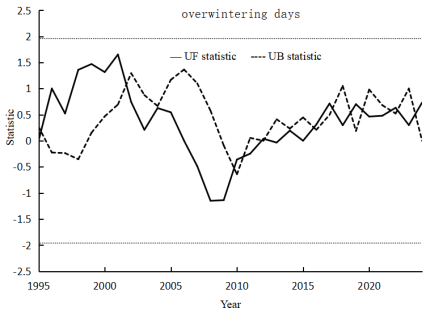
Figure 3. Mutation Test of Winter Wheat Overwintering Days in Changji City from 1995 to 2024.
The Mann-Kendall method was used to test the number of winter wheat overwintering days in Changji City from 1995 to 2024 (see Figure 3). The results showed that there was no obvious mutation in the overwintering period of winter wheat in Changji City in the past 30 years.
3.4. Trend of the Start Date of Winter Wheat Overwintering
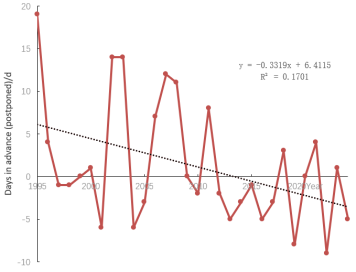
Affected by the weather conditions in the early period of overwintering, the start date of winter wheat overwintering is different every year. According to statistics, the start date of winter wheat overwintering in Changji City over the years is November 14. By comparing the number of days in advance or postponed between the start date of winter wheat overwintering in Changji City from 1995 to 2024 and the start date of winter wheat overwintering over the years, the change trend of the start date of winter wheat overwintering in Changji City can be obtained (see Figure 4).
Figure 4. Variation Trend of Winter Wheat Qverwintering Start Period in Changji City from 1995 to 2024.
The analysis showed that the start date of winter wheat overwintering in Changji City in the past 30 years showed a significant advance trend, and the trend coefficient r = 0.4124. Through the significance test of 0.05, the advance rate was 3.3 d / 10 a, and the trend was more obvious after 2010.
3.5. Correlation Analysis of Winter Wheat Overwintering Period
Using scatter plot and Pearson correlation coefficient method, the correlation analysis of winter wheat overwintering days and climatic factors such as average temperature, maximum temperature, minimum temperature, precipitation, sunshine hours and ≥0°C accumulated temperature in Changji City from 1995 to 2024 was carried out, and Table 1 was obtained.
Table 1. The Correlation and Coefficient Between Winter Wheat Overwintering Days and Climatic Factors in Changji City.

Climatic factor

Correlation equation

Correlation coefficient

Daily average temperature

y=-2.5092x+108.27

0.4913**

Daily average maximum temperature

y=-3.8480x+116.05

0.5813**

Daily average minimum temperature

y=-1.4606x+110.95

0.4060*

Precipitation

y=0.1529x+121.34

0.2243

Sunshine hours

y=-0.0208x+143.05

0.2105

≥0°C accumulated temperature

y=-0.1181x+143.01

0.7001**

Annotation: *, ** represent the significance level test of 0.05 and 0.001 respectively.
It can be seen from the above table that the correlation coefficient between the number of winter wheat overwintering days and climatic factors in Changji City is between 0.2105 and 0.7001. The correlation coefficients of the daily average temperature, the daily average maximum temperature and ≥ 0°C accumulated temperature all pass the significance test of α = 0.001, and the correlation coefficient of the daily average minimum temperature passes the significance test of α = 0.05, indicating that there is a strong negative correlation between the number of winter wheat overwintering days and the daily average temperature, dailyaverage maximum temperature, daily average minimum temperature and ≥ 0°C accumulated temperature during the overwintering period in Changji City. When the above climatic factors show a downward trend, the number of winter wheat overwintering days will show an extended trend.
4. Conclusion and Discussion
From 1995 to 2024, the daily average temperature, daily average maximum temperature and daily average minimum temperature of winter wheat in Changji City showed a significant downward trend during the overwintering period, and the decline rates were 1.3, 0.5 and 2.2°C / 10 a, respectively. The precipitation during the overwintering period showed no significant downward trend, and the sunshine hours and ≥ 0°C accumulated temperature did not change significantly.
In the past 30 years, the number of winter wheat overwintering days in Changji City showed an insignificant extension trend. The maximum value appeared in 2010, which was 145 days, and the minimum value appeared in 2008, which was 103 days. The beginning of overwintering of winter wheat showed a significant advance trend, and the advance rate was 3.3 d / 10 a.
There is a strong negative correlation between the number of winter wheat overwintering days in Changji City and the daily average temperature, daily average maximum temperature, daily average minimum temperature and ≥ 0°C accumulated temperature during the overwintering period. When the above climatic factors show a downward trend, the number of winter wheat overwintering days will show an extended trend, which is consistent with the research results of Abuduk Rim Abbasi et al .
In the past 30 years, the number of winter wheat overwintering days in Changji City showed an extended trend, which was related to the significant decrease of daily average temperature, daily average maximum temperature and daily average minimum temperature. The winter wheat forms strong seedlings before winter, and the light, temperature and water configuration are suitable in the three ecological stages of freezing and thawing, stable freezing and thawing, which is conducive to the safe overwintering of winter wheat . Therefore, it is necessary to strengthen the management of winter wheat production technology before and after winter in Changji City to ensure stable and high yield of winter wheat.
Abbreviations

Mann-Kendall method

It Is a Non-parametric Test Method Recommended by the World Meteorological Organization and Widely Used in Practical Research. It Is One of the Time Series Trend Analysis Methods.

Pearson correlation coefficien

It Is to Measure Whether Two Data Sets Are on A Line, Which Is Used to Measure the Linear Relationship Between Fixed Distance Variables.

Author Contributions
Jian Yong-mei is the sole author. The author read and approved the final manuscript.
Funding
Changji’s ‘Tingzhou Talents’ Talent Plan-Tingzhou Excellent Three Rural Talents Special Action Funding.
Conflicts of Interest
The author declares no conflicts of interest.
References
[1] JI Peng. Study on the Optimization of Oasis Agricultural Production Layout Based on Development Suitability Evaluation—taking Changji Prefecture of Xinjiang as an example [D]. Urumqi: xinjiang normal university, 2022: 4-10.
[2] JIAN Yong-mei, LI Jian-gang, FANG Wen. Variation Characteristics of Extreme Precipitation in Main Flood Season of Changji Oasis from 1971 to 2020 [J]. Desert and Oasis Meteorology, 2024, 18(4): 23-29.
[3] Changji Municipal People 's Government. Statistical Bulletin of National Economic and S-ocial Development of Changji City in 2023 [EB/OL].
[4] LEI Jun-jei, CHENG Xing-wu, ZHAO Qi, et al. High-yielding cultivation techniques of winter wheat in northern Xinjiang [J]. Rural Science & Technology, 2014(2): 5-6.
[5] JING Yi-gang, FAN Jian-zhong, GAO Mao-sheng. Influences of the Climate Warming on Developm-ental Stages of Winter Wheat in Shanxi [J]. Journal of Triticeae Crops, 2013, 33(2): 389-396.
[6] LI Tong-xiao, ZHAO Guo-qiang, LI You. Climate Chang and its Impacts on During of Winter Wh-eat Overwintering Stage in Henan Province [J]. Chinese Journal of Agrometeorology, 2009, 30(1): 143-146.
[7] HU Xin-yu, WANG Jing, FENG Li-ping. Analysis on Agro-climeatic Elements Variation during Winter Wheat Growing Season in North China Plain [J]. Chinese Journal of Agrometeorology, 2013, 34(3): 317-323.
[8] XIE Fang, HUANG Xin-lin, LIU Yang, et al. Effects of the Climate Changes during the Winter Wheat Growth Period in Bachu County [J]. Desert and Oasis Meteorology, 2018, 12(5): 90-94.
[9] WU Yanfeng, BAKE Batur, LU0 Nana, et al. Variations in Water Requirement of Winter Wheat at Different Growth StagesandIts Climatic Causein Shihezi Region [J]. Bulletin of Soil and Water Conservation, 2016, 32(1): 69-74.
[10] MAQian-qian. Analysis of Winter Wheat Phenology Evolution in Northern China Wheat Zone u-nder Global Warming [J]. Journal of Triticeae Crops, 2021, 41(6): 762-770.
[11] Mann H B. Non-parametric Test Against Trend. Econometic, 1945, 13(3): 245-259.
[12] Li L J, Zhang Lu, Wang Hao, et al. Assessing the impact of climate varialility and humanactivities on streamflow from the Wuding River basin in China [J]. Hydrological Processe-s, 2007, 21(25): 3485-3491.
[13] Abudoulerimu Abasi, Patima Bbudouaini, Wang Rongmei. et al. Variation Characteristics and I-mpact of Climate Factors During Winter Wheat Growth in Kashgar, Xinjiang [J]. Chinese Agr-icultural Science Bulletin, 2016, 32(27): 34-41.
[14] MA Zhao-ting, WANG Ru-bing. Autumn sowing and precautions of winter wheat in northern Xinjiang [J]. Xinjiang Agricultural Science and Technology, 2021(6): 30.
[15] JIANG Shu-hua. Construction of winter wheat cultivation and management technology framew-ork [J]. Agricultural Development and Equipmen, 2021(8): 217-218.
[16] WANG Ji-hui. Study on High Yield Cultivation Techniques of Winter Wheat in Xinjiang [J]. T-echnology and Equipment, 2020, 45(6): 116-117.
Cite This Article
  • APA Style

    Yong-mei, J. (2025). Climate Change and Impact Analysis of Winter Wheat Overwintering Period in Changji City in Recent 30 Years. International Journal of Applied Agricultural Sciences, 11(6), 232-238. https://doi.org/10.11648/j.ijaas.20251106.13

    Copy | Download

    ACS Style

    Yong-mei, J. Climate Change and Impact Analysis of Winter Wheat Overwintering Period in Changji City in Recent 30 Years. Int. J. Appl. Agric. Sci. 2025, 11(6), 232-238. doi: 10.11648/j.ijaas.20251106.13

    Copy | Download

    AMA Style

    Yong-mei J. Climate Change and Impact Analysis of Winter Wheat Overwintering Period in Changji City in Recent 30 Years. Int J Appl Agric Sci. 2025;11(6):232-238. doi: 10.11648/j.ijaas.20251106.13

    Copy | Download

  • @article{10.11648/j.ijaas.20251106.13,
      author = {Jian Yong-mei},
      title = {Climate Change and Impact Analysis of Winter Wheat Overwintering Period in Changji City in Recent 30 Years},
      journal = {International Journal of Applied Agricultural Sciences},
      volume = {11},
      number = {6},
      pages = {232-238},
      doi = {10.11648/j.ijaas.20251106.13},
      url = {https://doi.org/10.11648/j.ijaas.20251106.13},
      eprint = {https://article.sciencepublishinggroup.com/pdf/10.11648.j.ijaas.20251106.13},
      abstract = {Changji City is located in the main producing area of winter wheat in Xinjiang. It is of great significance to study and analyze the regional climate change and its impact on the overwintering period of winter wheat for making full use of the ratio of light, heat and water resources and developing grain production according to local conditions. The data of national meteorological station and the observation data of winter wheat development period in Changji City from 1995 to 2024 were selected. The linear regression equation, climate tendency rate, Mann-Kendall and Pearson correlation coefficient method were used to analyze the variation characteristics of average temperature, maximum temperature, minimum temperature, precipitation, sunshine hours, ≥0°C accumulated temperature and other climatic factors during the overwintering period of winter wheat in Changji City, and to judge the key climatic factors affecting the overwintering period of winter wheat. The results showed that: (1) During the overwintering period of winter wheat in Changji City, the daily average temperature, daily maximum temperature and daily minimum temperature all showed a significant downward trend, and the downward rates were 1.3, 0.5 and 2.2°C/10a, respectively. The downward trend of precipitation was not significant, and the changes of sunshine hours and ≥0°C accumulated temperature were not obvious; (2) There was a strong negative correlation between the number of winter wheat overwintering days and the daily average temperature, daily maximum temperature, daily minimum temperature and ≥0°C accumulated temperature. (3) In recent 30 years, the number of winter wheat overwintering days in Changji City showed an increasing trend, which was related to the significant decrease of daily average temperature, daily maximum temperature and daily minimum temperature.},
     year = {2025}
    }
    

    Copy | Download

  • TY  - JOUR
    T1  - Climate Change and Impact Analysis of Winter Wheat Overwintering Period in Changji City in Recent 30 Years
    AU  - Jian Yong-mei
    Y1  - 2025/12/29
    PY  - 2025
    N1  - https://doi.org/10.11648/j.ijaas.20251106.13
    DO  - 10.11648/j.ijaas.20251106.13
    T2  - International Journal of Applied Agricultural Sciences
    JF  - International Journal of Applied Agricultural Sciences
    JO  - International Journal of Applied Agricultural Sciences
    SP  - 232
    EP  - 238
    PB  - Science Publishing Group
    SN  - 2469-7885
    UR  - https://doi.org/10.11648/j.ijaas.20251106.13
    AB  - Changji City is located in the main producing area of winter wheat in Xinjiang. It is of great significance to study and analyze the regional climate change and its impact on the overwintering period of winter wheat for making full use of the ratio of light, heat and water resources and developing grain production according to local conditions. The data of national meteorological station and the observation data of winter wheat development period in Changji City from 1995 to 2024 were selected. The linear regression equation, climate tendency rate, Mann-Kendall and Pearson correlation coefficient method were used to analyze the variation characteristics of average temperature, maximum temperature, minimum temperature, precipitation, sunshine hours, ≥0°C accumulated temperature and other climatic factors during the overwintering period of winter wheat in Changji City, and to judge the key climatic factors affecting the overwintering period of winter wheat. The results showed that: (1) During the overwintering period of winter wheat in Changji City, the daily average temperature, daily maximum temperature and daily minimum temperature all showed a significant downward trend, and the downward rates were 1.3, 0.5 and 2.2°C/10a, respectively. The downward trend of precipitation was not significant, and the changes of sunshine hours and ≥0°C accumulated temperature were not obvious; (2) There was a strong negative correlation between the number of winter wheat overwintering days and the daily average temperature, daily maximum temperature, daily minimum temperature and ≥0°C accumulated temperature. (3) In recent 30 years, the number of winter wheat overwintering days in Changji City showed an increasing trend, which was related to the significant decrease of daily average temperature, daily maximum temperature and daily minimum temperature.
    VL  - 11
    IS  - 6
    ER  - 

    Copy | Download

Author Information
  • Changji Meteorological Bureau, Changji, China

    Biography: Jian Yong-mei (1976-), female, Han nationality, Master's Degree, Senior Engineer, The main research directions are resources and environment, meteorological services and applied meteorology.
  • Abstract
  • Keywords
  • Document Sections

    1. 1. Introduction
    2. 2. Materials and Methods
    3. 3. Results and Analysis
    4. 4. Conclusion and Discussion
    Show Full Outline
  • Abbreviations
  • Author Contributions
  • Funding
  • Conflicts of Interest
  • References
  • Cite This Article
  • Author Information